
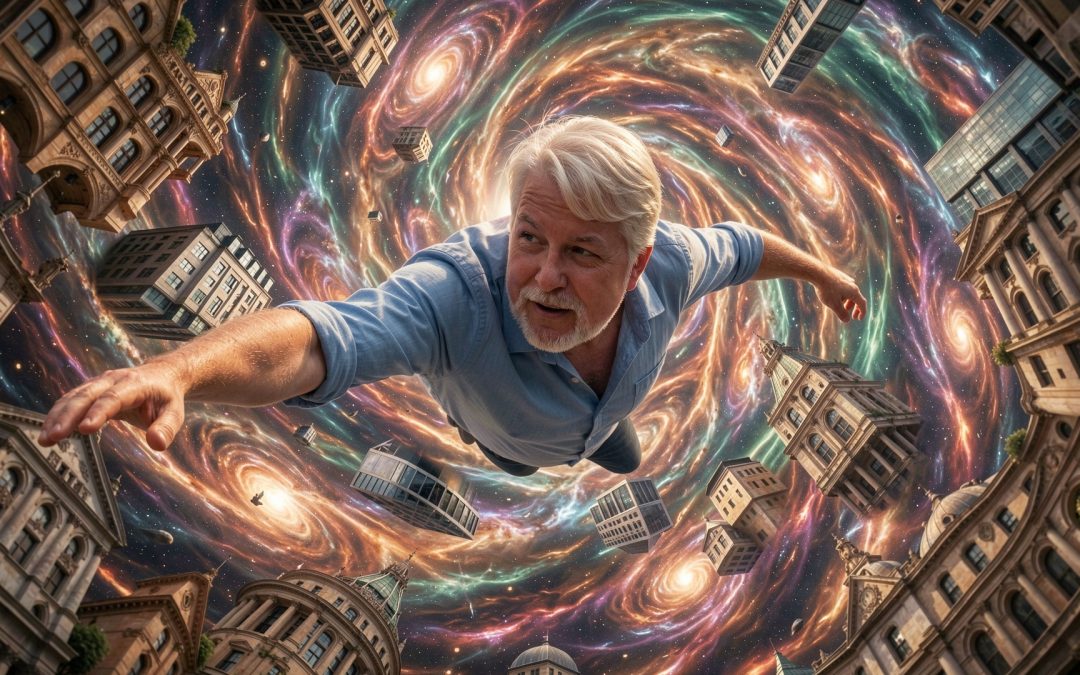
Every so often, the Muse doesn’t just hand me an idea; she opens a door, gives me a gentle shove or a kick in the backside, then leaves me to work out where I’ve landed. That’s more or less how Shuttlers happened. One moment I was writing about a young man smuggling forbidden books. The next, I was down a rabbit hole with no obvious bottom, and an entire Multiverse was waiting for me at the other end of it.
The Door I Didn’t Know I’d Opened
It started, as it always does, with twenty minutes and a single idea: What the Dickens?
Justin Wilson is caught red-handed smuggling books between one version of Earth and another, specifically a Charles Dickens novel. That was the whole prompt. I had no Multiverse in mind when I wrote it. I had no Sidewise Directorate, no Pol Atkinson, no sense whatsoever of how large this was about to get.
But the moment I wrote ‘between one version of Earth and another,’ I’d opened a door I hadn’t noticed was there. And once a door’s open, the Muse doesn’t believe in closing it again out of politeness.
Falling, Not Climbing
People sometimes imagine worldbuilding as something you do deliberately: sit down, draw a map, decide on the rules, and build upward, brick by brick. That’s never been how it’s worked for me. With Shuttlers, it felt much more like falling than building. Every answer I gave myself about how Justin’s world worked opened up two new questions I hadn’t thought to ask. Why could some people Shuttle and not others? What prevented every reality from being raided into ruin? Who would possibly take it upon themselves to police something like that?
That last question is where the Sidewise Directorate came from, not planned, not plotted, just the obvious, inevitable answer the story handed me the moment I asked it out loud. And once the Directorate existed, it needed someone to embody it. That’s where Pol arrived, fully formed, a patrolman with no patience for rules or smugglers, and, infuriatingly for him, a grudging respect for this one in particular, which matured into friendship.
Losing Track of How Deep I’d Gone
I remember the exact moment the short story stopped being a short story. Annalisa and I were discussing how my book, Paranormal City, wasn't finding traction with publishers. She told me it was because it spanned too many genres, and that publishers get antsy when that happens. Instead, she suggested I select one or two stories as the basis for a novel in a single genre. Thus, the novel form of Shuttlers was born.
After that, there wasn’t a single dramatic turn, just a steady, dizzying accumulation; another reality needing its own internal logic, another rule about what Shuttling actually costs a person, another consequence rippling out from a choice Justin made three scenes earlier that I hadn’t realised mattered yet.
By the time I looked up, I wasn’t holding four or five hundred words any more. I was holding my first full-length novel, and a Multiverse that had quietly grown enormous behind my back while I was busy just following Justin from one page to the next.
What the Fall Actually Felt Like
If I’m honest, there were moments that felt less like exhilarating discovery and more like mild panic. I sometimes had the sense that I’d started something I couldn’t possibly hold together, that somewhere along the way I’d planted a detail that would contradict something I’d write three chapters later. As a Pantser with no notes and no outline, I know this fear isn’t paranoia. It’s a near certainty. Read, revise, edit, wash, rinse, repeat earned its keep on this one more than on almost anything else I’ve written, catching the places where the Multiverse had quietly tripped over its own feet.
But there was exhilaration too, plenty of it. Every new reality Justin stumbled into felt like genuinely finding something, not inventing it; the particular thrill of discovery that’s the entire reason I write the way I do in the first place.
Where the Rabbit Hole Led
Eventually, the falling stopped, not because I ran out of Multiverse, but because the story Justin and Pol were actually telling reached the place it needed to reach. Shuttlers found its ending, found a publisher, and went on to pick up a joint Writers Forum award alongside Paranormal City, which still slightly astonishes me when I think back to that first innocent twenty minutes about a book smuggler.
And now, of course, I’m back down the same hole. The sequel has us returning to a Multiverse that, true to form, still holds more than I bargained for. I don’t yet know exactly how deep this particular fall goes. I never do at the start. That’s rather the point.
The main story centres on other characters in the far future of the Multiverse and the Omniverse that contains it, but Pol and Justin still get a look in.
If you ever wonder how a story this big came from someone who refuses to plan anything in advance, that’s the honest answer. I didn’t build the Multiverse. I fell into it, just as Justin did, and I’m still finding my footing.