
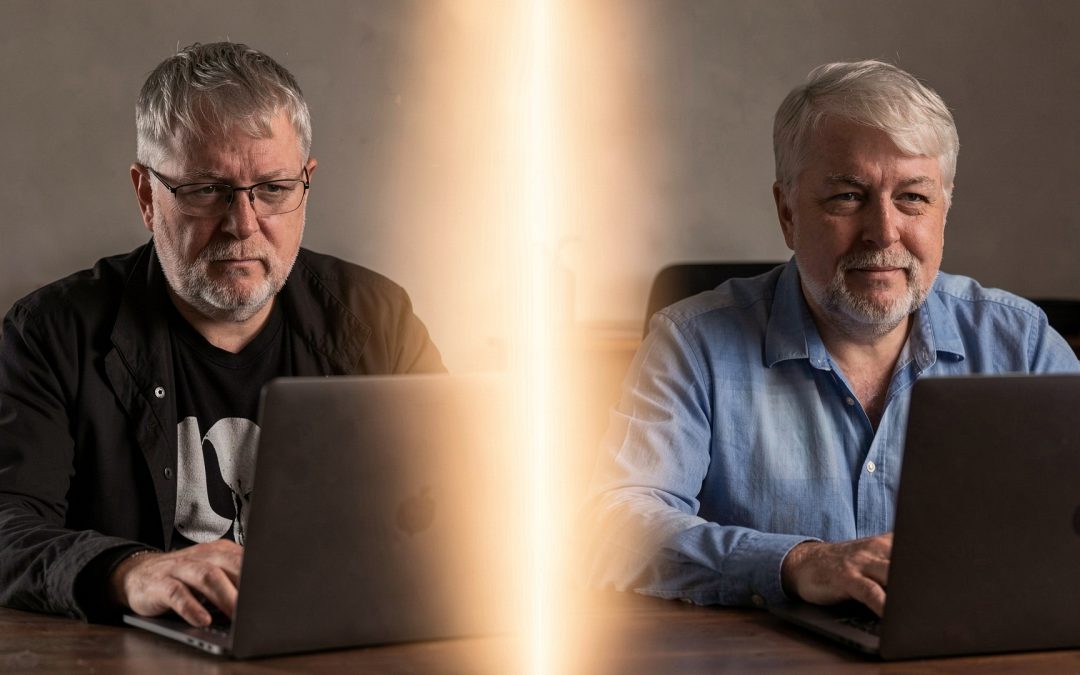
Nearly fourteen years and 2.22 million words are plenty of time for a process to evolve, even one as instinctive and chaotic as mine. Looking back at where I started and where I am now, the differences are smaller than I expected but still real.
Then
Uncertainty Whether This Was ‘Allowed’
In the early days, I genuinely wasn’t sure Pantsing was a legitimate way to write a novel. I briefly and disastrously tried to become a Plotter instead, assuming that was simply what serious writers did. It took a stalled novel and Annalisa’s book on Pantsers (Storytelling for Pantsers) to convince me otherwise.
Now
Complete Trust in the Process
These days, I don’t question the chaos anymore. A prompt, twenty minutes, four or five hundred words, and total faith that the rest will follow eventually, however unpredictably. There have been times when I began a story, often during a writing salon at the Writing Gym, only to finish it months or even years later. For instance, I was challenged to write a romance story at Halloween, while everyone else was writing horror stories. I finally completed it two and a half years later.
That trust took years to build, and it’s probably the single biggest difference between then and now.
Panic That I Would Choke
Back when I was starting out as a writer, my biggest worry was running out of ideas and words. An example of this was the epic novel I started out with. When I began, I worried that I wouldn’t even be able to make a novella out of it, i.e., somewhere between 40,000 and 60,000 words.
Worry I Won’t Have Enough Space
These days, the worry I have about that particular piece of work is: ‘How am I going to handle something so big?’ It’s already over 147,000 words long, and I reckon there’s probably another 30-40,000 words to go. The thing is, I don’t know how to split it because there’s no way to make a clean break without leaving the reader hanging. There are no convenient cliffhangers and no natural breaks in the flow of the story. If I make a trilogy out of it, Part One is far larger than the other two. I did think of making a duology. Part One has Act One, and Part Two has Acts Two and Three, but that doesn’t work either.
One Project at a Time, More or Less
Early on, I worked on one thing at a time: the stalled epic novel, then the short stories that became Paranormal City. The sprawling, thirty-seven-books-at-once chaos of my current life simply didn’t exist yet.
An Unmanageable Number of Projects
Whether this is progress or simply a different kind of chaos, I genuinely couldn’t tell you. But the scale has changed enormously, and I’ve had to develop at least some loose systems, imperfect as they are, to keep from losing track entirely.
How I Work Now
I have, however, started using various technologies to make my life easier.
Evernote
Ever since I started, I have been using Evernote to keep all my new ideas together. I have one notebook for each genre, and each contains hundreds, if not thousands, of prompt ideas. Some are ideas that popped into my head at one time or another. Others are prompts I found online, ideas I picked up from talking with people or watching television, and some even come from the prompt books I used to buy when I was starting out before I realised that my Muse was so prolific. If I were to write all the ideas I have stored there, I would probably still be at it when the Sun turns into a red giant in five billion years’ time, mainly because my Muse keeps giving me new ideas on top of all the others.
Scrivener
On the other hand, when I write, I use Scrivener. I wrote my very first book, Unleash Your Dreams: Going Beyond Goal Setting, using Microsoft Word. It was a pain in the proverbial, especially when moving sections around. It was all cut and paste.
Now, each of my books has its own Scrivener file structure. While I’m working on that, if a particular story or section needs to be moved elsewhere, it’s as simple as dragging it from its current location and dropping it where it needs to go.
It has a couple of other advantages, too, because it was designed by writers for writers.
-
- If you stop writing for any reason, it automatically saves your changes.
- Each part, chapter, section, scene, etc., is stored in a separate file, but the program handles this automatically, so you do not need to worry about it.
Dropbox
Finally, I store all my Scrivener manuscripts on Dropbox. For those who don’t know it, Dropbox stores any data you like in the cloud. The cloud is one of the safest places to store data because it is stored in multiple locations simultaneously. If one data center goes down, the data can be reloaded from the others at a later date, but the data are not lost.
The point is that all your Dropbox files are stored on your computer. The Dropbox app runs in the background, and when it detects a change to a file, it uploads a copy to the cloud over the Internet. This, together with Scrivener’s autosave function, means I never lose anything in the event of a power cut, except for anything I might have written in the past few seconds.
What Hasn’t Changed at All
The fundamentals remain exactly the same: no outlines, no plans, the Muse striking whenever she pleases, often in the early hours of the morning, and editing that requires read, revise, edit, wash, rinse, repeat more times than I’d like to admit. Fourteen years on, that core hasn’t shifted an inch, and I don’t expect it ever will.