
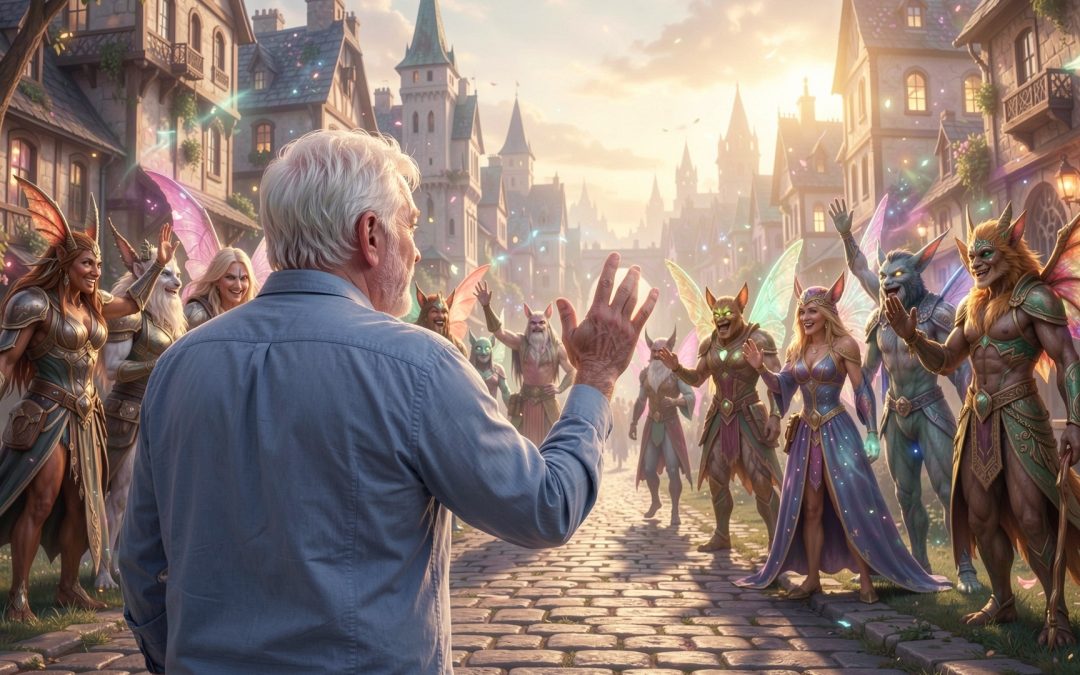
Of all the genres on my fairly extensive list, urban fantasy is the one I find myself returning to most often. Paranormal City is the clearest and largest example, but far from the only one. I thought it was worth examining why properly.
The Appeal of the Familiar Made Strange
There’s something I find endlessly satisfying about taking an ordinary setting, a street, a building, a city not unlike the ones I know, and letting something paranormal sit just beneath the surface. It’s a different kind of magic from full secondary-world fantasy. The familiarity does half the work, making the strangeness hit harder because the reader already trusts the setting.
My writing coach, Annalisa, holds writing salons every two weeks as part of our training. We write to a prompt for 20 minutes, then receive feedback from the facilitator and our fellow writers. She also hosts open salons, which anyone can join, four times a year. If you are interested in joining the next one in October, you can sign up here.
One of the pieces of feedback I get in these salons, again and again, is that people love my world-building. I start out with everything seemingly quite normal, and then I drop a little fact, something that is not part of the mundane world, and then another one, and a third. Eventually, we reach the point where we are clearly well away from the ‘normal world’.
In one story, for instance, I described a female character as follows: “She was a real looker. Red hair, red lips, red eyes.” That was, of course, because she was a succubus, a female demon, but as I read it, I could hear the odd gasp, as if my listeners were all going, “WTF?”
At this point, my readers are hooked and will follow me wherever I’m going to lead them, even if it’s strange.
It Lets Every Other Genre In
Urban fantasy, more than almost any other genre I write in, seems to welcome the genre-mashing I can’t help doing (see Genre Mashup Confessions). Horror slots in easily. So does noir, dark humour, science fiction, even the odd detective story. The genre is loose enough as a category that it doesn’t fight the other instincts the Muse keeps bringing to the table. It even allows in romance!
The City Itself Became a Character
Paranormal City isn’t just a backdrop; it’s developed its own logic, its own dark corners, and its own sense of what’s normal within its boundaries. I find myself drawn back to it the way you’d return to a real place you know intimately, except this one keeps revealing new streets and districts I hadn’t noticed before, volume after volume.
The City is the true narrator of the stories, their author, and everyone else is no more than a bit player in one or more of its dramas. It says so explicitly in the introduction to the first book: “Just as all my inhabitants are part of me, I am part of them.”
Moreover, as it is the core of all cities across all realities everywhere, every other story of mine, in one respect or another, can be regarded as belonging to Paranormal City. “I am the City; the archetypal prototype of all cities and other conurbations everywhere. They determine my many shapes, and I guide their many evolutions.”
Why It Suits a Pantser Particularly Well
Urban fantasy doesn’t require the same level of exhaustive upfront world-building as epic fantasy. You can discover the rules of the paranormal layer gradually, story by story, the same way I discover everything else: by writing it and finding out. That’s part of why it’s been such a natural home for someone whose Muse refuses to plan anything in advance. Or does she? See I May Be a Pantser, But My Muse Is Definitely a Plotter.
I suspect I’ll keep coming back to it for as long as I’m writing, simply because there always seems to be more of the city left to explore.