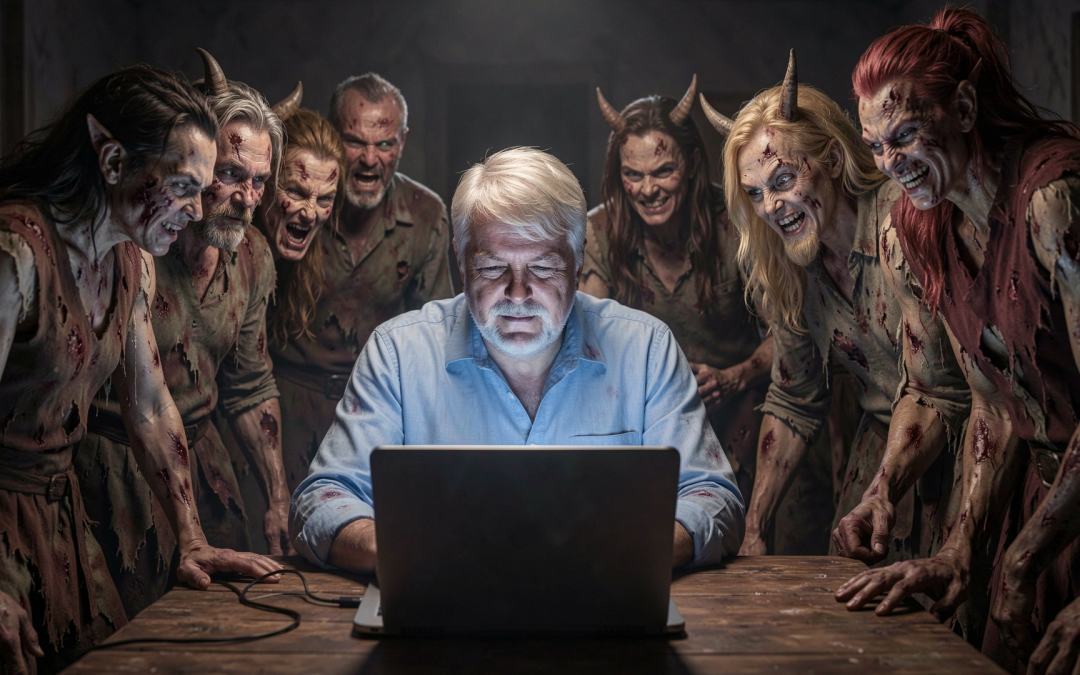
I’ve written about how, among other genres, my fairy tales sometimes wander into darker, stranger territory than the traditional versions (https://stephenoliver-author.com/genre-mashup-confessions/). I wanted to dig a bit deeper into why I think fairy stories belong to adults just as much as children, and why I keep writing them with grown-up readers firmly in mind.
The Myth That Fairy Tales Are Just for Children
Somewhere along the way, fairy tales were filed away as children’s entertainment — softened, simplified, given tidy endings. But the oldest versions of these stories were rarely gentle. They dealt in genuine loss, genuine cruelty, genuine consequence, genuine terror and horror. For instance, in the original tale of Little Red Riding Hood, both she and her grandmother were eaten by the wolf. That was it; no rescue by a jolly woodsman. I think something valuable got lost when we decided these stories needed to be made safe.
Disney has a lot to answer for that. J.R.R. Tolkien famously despised Walt Disney and his films after seeing Snow White and the Seven Dwarfs with his friend C.S. Lewis. He felt Disney ‘Disney-fied’ rich, deep folklore, turning it into cheap, cute cartoons. He believed fairy tales needed to be dark and dangerous to prepare children for real-life trials, and he hated Disney’s tendency to water down and trivialise serious threats to make stories ‘kid-friendly’. Furthermore, in his view, fairy tales were also profound adult myths.
When the author sold the rights to The Lord of the Rings in the 1960s, he added a clause that legally banned Disney from ever adapting his work.
What Grown-Up Fairy Tales Let Me Do
Writing fairy stories for an adult audience means I don’t have to soften the cost of a transformation or guarantee a happy ending just because the structure feels familiar; often, ‘happily ever after’ has no justification within the story. I can let a character make a genuinely bad bargain or decision and suffer the genuinely bad consequences, the way the old stories used to, before everything got smoothed over for bedtime reading.
I love to follow fairy tales, tropes, mythology, and other well-known stories down a dark alley and ambush them, mugging and kicking them while they’re down. What staggers out, battered and bruised, are twisted fairy tales that bear a vague resemblance to their originals yet don’t end the way you’d expect. That doesn’t mean there aren’t happy endings, of course, but those are usually reserved for stories that traditionally end badly.
Why the Old Structure Still Carries So Much Weight
There’s something about the familiar shape of a fairy tale — the journey, the trial, the transformation — that lets you sneak in genuinely adult themes without the reader’s guard going up the way it might in a story that announces itself as Serious Literary Fiction from the first line. The familiar shell does a lot of quiet work, letting darker material sneak in more gently than it otherwise might.
Where Mine Tend to End Up
My fairy stories for grown-ups usually end in a more ambiguous place than ‘they lived happily ever after’, for reasons I mentioned before. Not bleak for its own sake — just honest that transformations cost something, that wishes granted rarely come without complications, that the wicked aren’t always punished, and that the good aren’t always rewarded. I think adult readers, on the whole, find that more satisfying than the tidy version, even when it’s less comfortable.
So if you pick up one of my fairy tales expecting something safe for children — do check the ending first. I make no promises.